
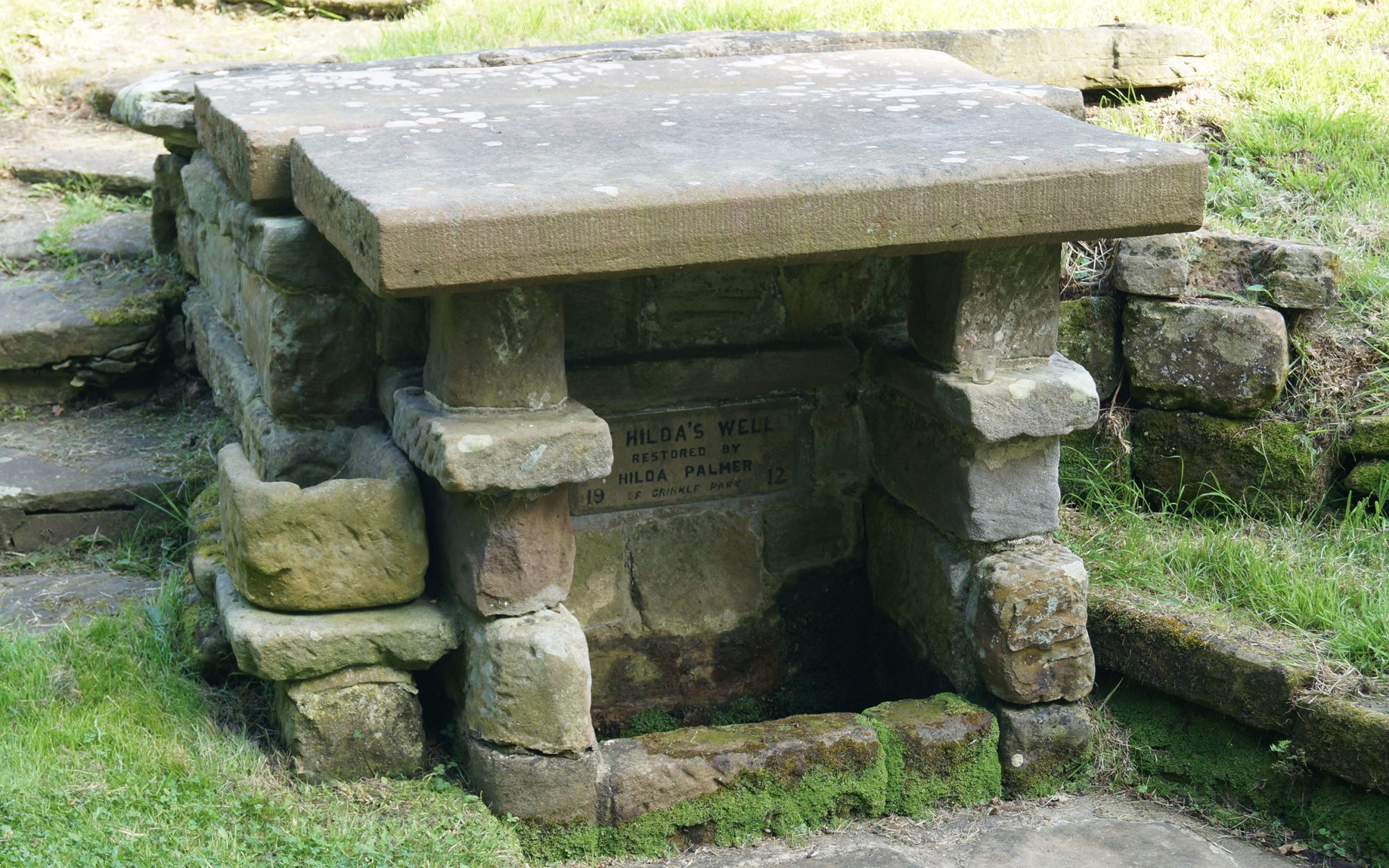
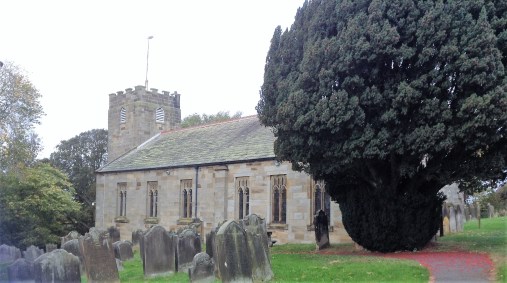
Hinderwell’s Church, is dedicated to St. Hilda, but the Holy Well in the churchyard has much earlier origins and gave its name to the village.
The original church was probably of 12th century date, and was a simple structure. The current church was built in 1773, consisting of a single rectangle of 67ft 6in by 28ft 6in, with a tower at the west end. The tower also serves as a porch, and the vestry is built onto its north wall. There are six rectangular windows on each side, and a three light window at the east end. The tower was rebuilt in 1817, and the side windows were given gothic tracery inside the rectangles in 1895.
It is constructed of wrought stone with quoins at the angles and is lighted by six square-headed windows on each side, and at the east end is a window of three lights of ‘Venetian’ type now built up and treated internally as an altar-piece. This window, the middle light of which has a semi-circular head, is quite plain outside, but internally has an entablature over the side lights carried on Tuscan pilasters, and a keyed architrave to the middle opening. The north and south windows, which were of the usual plain 18th century type, were gothicized in 1895 and now have perpendicular tracery in the heads.
The roof is eaved and has been re-slated and the east gable is quite plain. There is a gallery at the west end erected in 1818, now containing the organ. The font, pulpit, and all the internal fittings are modern. The tower, which contains the gallery staircase, has round-headed belfry windows and south doorway.
The plate includes a mediaeval chalice and paten of great interest. They are both apparently of late 15th-century date, c. 1490, and the chalice is of parcel-gilt. It has a deep bowl and hexagonal stem and foot. The gilt portions are the inside and rim of the bowl, the knop, and the front compartment of the foot. In this latter is engraved a crucifix with attendant figures of St. Mary and St. John. The chalice is 6¼ in. high. The paten is a thin plain saucer-shaped plate with a plain rim. In the centre is the Agnus Dei, with growing grass and flowers. There are slight traces of gilding on the paten, the diameter of which is 6¼ in. The plate also includes a cup of 1777, without inscription, and a pewter flagon.
Church Registers date back to 1601, written in Latin.
Church maintenance is the responsibility of the Parochial Church Council. In 2019 they successfully applied for funding to provide kitchen and toilet facilities, with assistance from an interest free loan from Jet Coast Development Trust. This will increase the range of uses and increase revenue to sustain this very valuable part of the village’s heritage.
 HINDERWELL